Sunday, March 15, 2009
(Click here for today's photos.)
We are here. I wake up with the acute awareness of having reached my city - Jerusalem. My joy is a bit tampered after a look outside my window. Since I am on the subterranean level of the hotel where there is a walk-out patio, I can quickly detect the puddles with raindrops forming concentric circles as they fall in the already standing water. It wouldn't be a true trip to Israel without some rain, especially in March. We already had a bit of a precursor yesterday when it rained in the Galilee over night. But now it is really coming down. Not a pretty day to be walking around Jerusalem, but any day with rain is a good day in Israel. The land so urgently needs it!
 After breakfast (oh, I remember all the good food at the Grand Court from last year!), we get on the bus. Dr. Caner jumps on to tell us that we will have a joint teaching time with the Thomas Road Baptist Church group on the Mount of Olives and that they will then go back to the hotel due to the rain (are you kidding me?). I give Joanne my cheapie rain cover I had brought since I have an umbrella. Our first stop, as we already heard from Dr. Caner, is at the top of the Mount of Olives. We get off, only to be greeted by rain. Blessings from heaven! You just have to keep a positive outlook on things. We snap our obligatory photos of each other in front of the Temple Mount, the Eastern Gate (or Golden Gate, a key site as far as Biblical prophecy goes) and the Dome of the Rock with its beautiful gold domed roof. Dr. Yates and I spend a few moments looking for the excavations of the City of David to our left, but they are too far away to make out much. We won't go through Hezekiah's Tunnel this year - bummer, because that would have taken us down in that direction, and Dr. Yates could have seen some of these excavations. Next trip! (Boy, that has become an often repeated phrase, hasn't it?) There is now a fabulous website that shows some of the site and the story of its excavation. We will get to go up on the Temple Mount, according to Tzvika, so that is something to definitely look forward to: to stand where the First and Second Temple once stood is a truly astounding experience.
 Dr. Caner's teaching is wonderful, but wet. I fear for the open Bible in his hand. Before we head down the Mount of Olives, we line up the entire Liberty contingent for the obligatory Jerusalem souvenir photo. This is a new experience for me - 182 bodies lined up for one commemorative shot. It is not easy juggling all the moving parts, such as hats, rain covers and umbrellas, and still getting a good group shot. I have to give the photographer a lot of credit - the photo came out quite well. On our way, we encounter some Arab vendors who are very smart: they hawk umbrellas. "One umbrella $5." Yeah right. Only first time Jerusalem visitors are that gullible (oops, quite a few are...). I tell a couple of those walking with me to wait a bit until most people clear out, then I walk up to the vendors and tell them I will buy two umbrellas - for $4. "Oh no, sorry Miss, cannot do that." "Thank you then and goodbye." "Wait, wait, okay, okay, but don't tell anyone you bought for this low." "Understood." Two minutes later, another fellow traveler realizes what just happened and says "Shoot, for $2, I would have bought one, too." So Elke walks back with $2 in her hand, and another umbrella is bought. We begin our descent down the Mount of Olives, and to come with us, you can take a look at this interactive map from a Jordanian travel agency.
 With the hotel with probably the best view of Jerusalem, the 7 Arches Hotel, behind us, we begin walking down the very steep road leading us down the Mount of Olives towards the Garden of Gethsemane. To our left, graves upon graves are lining the road next to us and are stretching far back along the mountain side. This is the Jewish Cemetery where Jews have longed to be buried since their return to the land of Israel in the belief that the resurrection when the Messiah comes will begin here. Zechariah 14:4 says "On that day his feet shall stand on the Mount of Olives that lies before Jerusalem on the east, and the Mount of Olives shall be split in two from east to west by a very wide valley, so that one half of the Mount shall move northward, and the other half southward.". Ezekiel 43:1-5 tells us that the glory of the God of Israel will return through the Eastern Gate. Christian graves are in the Kidron Valley below us (among them Oskar Schindler's tomb), and the Muslim ones are close to the Eastern (or Golden) Gate. I have learned on prior trips that Muslims want to stop the advance of the Jewish Messiah by putting a cemetery in front of the Eastern Gate. Wikipedia phrases it like this:
"In Jewish tradition, this is the gate through which the Messiah will enter Jerusalem. Ottoman Sultan Suleiman I sealed off the Golden Gate in 1541 to prevent the Messiah's entrance. The Muslims also built a cemetery in front of the gate, in the belief that the precursor to the Messiah, Elijah, would not be able to pass through, since he is a Kohen. This belief is erroneous because a Kohen is permitted to enter a cemetery in which primarily non-Jews are buried."
Well, there you have it in writing (even from Wikipedia): nothing and no one will stop the Messiah, whom we know to be Jesus Christ, Yeshua HaMashiach, from entering back into His city.
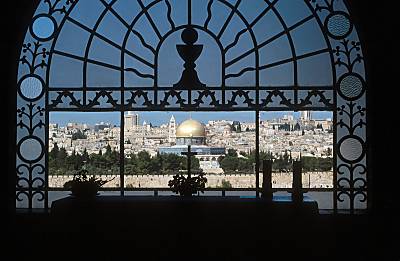
 We take a right detour off the road to enter into the garden of Dominus Flevit. This church features the most beautiful view of the Temple Mount through its chapel window. Dominus Flevit means "the Lord wept", and it is easy to see how this could have been the site where Jesus wept over Jerusalem. Matthew 23:37-40 describes Jesus' outpouring of grief over a non-believing Jerusalem:
"O Jerusalem, Jerusalem, the city that kills the prophets and stones those who are sent to it! How often would I have gathered your children together as a hen gathers her brood under her wings, and you would not! See, your house is left to you desolate. For I tell you, you will not see me again, until you say, 'Blessed is he who comes in the name of the Lord.'"
The reason we are stopping here is not for the view as regrettably there is a Catholic mass being held in the chapel, but rather to look at the ossuaries or bone boxes. These date back to the time of Jesus and truly give a good insight to us as to why Luke would describe Jesus telling a man who wanted to follow Him but first wanted to bury his father to follow Him now. With ancient Jewish burial rituals, it took one year to wait for the body to decompose and for the relatives to come back and gather the bones into an ossuary for final burial.
 With a worried look at the sky, I continue to walk towards the Garden of Gethsemane with the group. Worried because I know how slippery the stones along the road leading down can get, and I have seen more than one person there take a spill on a rainy day. Mercifully, we all make it down safely and enter into the already very crowded garden area. Most people here walk by the olive trees without realizing how old these trees truly are. They are called the "Silent Witnesses" for a reason because it is very likely that they were already producing fruit here during Jesus' time in Jerusalem. Olive trees can be chopped down to the roots and still regenerate. It is truly a beautiful symbol of life. One of my favorite verses in the Scriptures always seems to materialize before my eyes when I stand in front of the olive trees in the Garden of Gethsemane. It is in Romans 11:17-19 that the Jewish people are depicted as the original olive tree. It says:
But if some of the branches were broken off, and you, although a wild olive shoot, were grafted in among the others and now share in the nourishing root of the olive tree, do not be arrogant toward the branches. If you are, remember it is not you who support the root, but the root that supports you. Then you will say, "Branches were broken off so that I might be grafted in."

Wikipedia quotes Lewington and Parker from their book Ancient Trees by saying that "yields from trees grown from suckers or seeds are poor; it must be budded or grafted onto other specimens to do well". I found this particularly interesting in light of the passage in Romans. We have been grafted onto the strong tree of Judaism, and we, as New Testament believers, should never forget that. Jesus is not "blond, blue-eyed and seven feet tall", as my guide Mickey on trips past used to note, "...neither does He speak Italian". We enter the Church of All Nations, a beautiful church built on the grounds of the Garden of Gethsemane to commemorate Jesus' prayer there. In its center is an enclosed area of bedrock, which is by tradition the place where Jesus prayed prior to His arrest. I send Erin and Dr. Yates on a mission to find the American Eagle in the church. This church was built by donations from several nations (hence the name), and the national emblems are on the ceiling. My favorite part of the Church of All Nations is the view across the street: you are almost completely aligned with the Eastern Gate, which was also referred to as the Beautiful Gate in the New Testament in the story in Acts 3 of Peter healing the lame beggar.
 Leaving the Garden of Gethsemane, we cross the street to an area directly across, which is normally closed off. For a little donation, we are able to have our worship time there, which is very wonderful because outside of our (albeit large) group, there is no one there. After a time of praise and teaching, we are told we have a few minutes to look around. A thought pops into my head, and I excitedly walk over to Erin and Dr. Yates who are taking photos in front of the olive trees. Just around the corner from this garden, there is the Church of the Assumption (Mary's Tomb). I had only been there twice before briefly, but I remember how simply amazing I found this church with its beautiful crusader staircase. Dr. Yates and Erin are up for it, so we go on yet another one of our very quickly executed excursions. Most amazingly, outside of two old Greek Orthodox priests who eye us a bit suspiciously, there is no one else in the church. The staircase alone is worth walking down into the church. By Greek Orthodox tradition, this is where the tomb of Mary is. By Catholic tradition, her tomb is on Mount Zion in the Abbey of the Dormition, or Hagia Maria Sion Abbey, as it is now officially called. Take your pick. Reminds me of Bethlehem where there are three Shepherds' Fields to choose from. Dr. Yates gets a little too close to Mary's tomb for my taste. I can see a Greek Orthodox priest come running at him any second now. Dr. Yates is apparently too well behaved after all and doesn't get too close, as this does not happen. We make our way back out, thanking the old Greek Orthodox priest sitting at the bottom of the stairs for allowing us to visit. He almost breaks a smile. At the top of the stairs, we make a quick left, as this is where the Grotto of the Betrayal is. We can only take a quick look as another Greek Orthodox priest is about to detect us, but we note the engravings and decorations on the ceiling of this cave. After a very quick run towards where the buses are, we make it on the bus without anyone having noticed us missing.
 A few minutes later, we arrive at Mount Zion where we get off to visit David's Tomb and then the traditional Last Supper Room or Cenacle. David's Tomb has greatly changed since I first visited it a few years back. It used to be "unisex", meaning men and women were able to walk up to the tomb in the same room. Now, it is separated by a divider wall, a clear indication of how much the Orthodox Jews have begun to assert themselves on the strict gender separation required of them. Tzvika and I have a brief conversation about this topic as we are exiting, and he voices his annoyance at how much this is starting to impact every day life in Israel. A good example of this is the call for separated buses in Jerusalem. As we are talking, I have to suppress a chuckle as I see some of our guys exiting the men's section with their "french fry boats" on their heads. If you don't have a head covering, you can take one of the paper kippot (plural of kippah), but I have to say they look pretty silly. For a couple of dollars (or shekels), they could have looked a lot more stylish with a real kippah covering their heads. Dr. Yates heads back into the men's section armed with my camera to get a shot of the two Orthodox men studying the Talmud there. These old men study and study, yet they have no idea that their Messiah has already come and is getting ready to come back. When He returns, their eyes will open wide and "Baruch HaShem" (Blessed be the Name) will come from their lips, fulfilling Jesus' words.
 After exiting David's Tomb, we try to get up to the Upper Room, which is right above from David's Tomb, but Tzvika initially finds all doors closed. We finally make it up there, but it is already pretty crowded by other groups. I remember being in this room with only our small travel group a few years back, and it felt a lot more spacious, but now I just feel like a sardine and hardly in a worshipful mood. My favorite part there is actually a beautiful window with Arabic script, testimony to its earlier status as a mosque and the many Muslim occupiers (and others) of Jerusalem of the past.
Our final stop of the day is for a Dr. Caner teaching session at the Sheraton Hotel where our travel mates from Thomas Road Baptist Church are staying. Dr. Yates is just dying to get into the Old City and see some history, so I seek permission from my professor (oh...that just happens to be Dr. Yates) to skip the teaching session and investigate the Old City. We quickly find some others in the group who are willing to take our backpacks back to the hotel and discreetly exchange them with us later. We grab a city map at the reception - and off we go. A quick cab ride later, we are at Jaffa Gate and make our way into the Jewish Quarter. Our walk takes us past remnants of the ancient Cardo and the Broad Wall, a wall King Hezekiah built to defend against Assyria. After some quick shopping to get a Hebrew language sports shirt for Dr. Yates' son, we head down the stairs towards the Western Wall. On the way down, we pass the golden menorah, made from solid gold through donations of Jews around the globe and crafted by the Temple Institute. On prior trips, I have been to the Temple Institute to see their amazing collection of recreated vessels and priestly garments to be ready for the third Temple. They have even identified Cohen (priests) and have outfitted them with the appropriate garments. They are ready to go!
 After passing the security checks, we are finally at the Western Wall. Dr. Yates and Erin and I separate, as there are sides for men and women. To me, it is always a very emotional moment. Emotional not only because I am as close as I will ever be to where the Holy of Holies stood and the Shekinah glory of God resided in the First Temple, but also because I observe so many devout Jewish women and men who honestly seek God. Some are weeping as they are praying. For some, it may be rote worship, but with several it is obvious they are seeking God's face. My prayer at the Western Wall is not just for a speedy return of Jesus Christ, but also for Him to reveal Himself to these women and men who are so diligently seeking Him. I walk up to the wall to place a slip of paper into the wall. My friend Elke, who couldn't come with me on this trip, had asked me to place it in the wall for her. We meet up with Dr. Yates who has been to the wall on the men's side and head back through the Muslim Quarter towards our hotel. As we walk out of the Old City, we take a quick look at the Roman gate below the Damascus Gate. The gates of the Old City of Jerusalem are truly a beautiful sight to behold! A few minutes further, past Arab Muslim stores and through small side streets, we reach the hotel, but not before Dr. Yates almost gets arrested for (almost) taking a photo of the US Consulate on Nablus Road. Oops. I should have known, but didn't think. Good thing we have digital cameras - a film would have been gone, as the security guard checks Dr. Yates' camera. It turns out that we are the first ones at dinner, and the rest of the group slowly trickles in for dinner. We try to be as inconspicuous as possible. It was a very good day, despite the rain.


 Posts
Posts